
Web Development
True Power Systems
Two engineers in February, eight in September, and $1M in signed work TPS traces to leads from the 35 sites we built.
Web Development
Two engineers in February. Eight in September. $1M in work from the web.
Two engineers in February, eight in September, and $1M in signed work TPS traces to leads from the 35 sites we built.
True Power Systems, a service-disabled veteran-owned electrical engineering firm licensed in 24 states, had a one-page GoDaddy placeholder for a website. We built its 54-page firm site, then a power-studies site for all 24 states, then 10 MEP design sites laid out as drawing sets: 35 sites feeding one Sonor lead pipeline. Between February and September 2026 the firm went from two engineers to eight and quadrupled its monthly revenue, and it traces $1M in signed work to leads from these sites. (Growth figures are TPS's own, reported by its Director of Business Development.)
- Next.js Site Build
- Multi-state Microsite Network
- Technical SEO Implementation
- Sonor Forms And Lead Attribution
- Information Architecture
The site
$1M
Signed work TPS traces to web leads
Client-reported
per True Power Systems
4x
TPS monthly revenue since February 1
Client-reported
per True Power Systems
35
Live sites, one lead pipeline
Measured
8
TPS engineers on staff, up from 2
Client-reported
per True Power Systems
70%
Form inquiries via a microsite
Measured
54
Pages on the firm site
Measured
100/100
Lighthouse Accessibility, Best Practices, SEO
Measured
Challenges
What stood in the way
4 problems, and what each one took to clear.
Challenge 01
Problem
The whole website was one placeholder page
truepowersystems.com was a single GoDaddy Website Builder page: an 87KB document carrying about 780 characters of visible text, the words "Launching Soon", a contact form, and one internal link pointing back at itself. A firm licensed in 24 states had nothing for a prequalification reviewer to check.
Solution
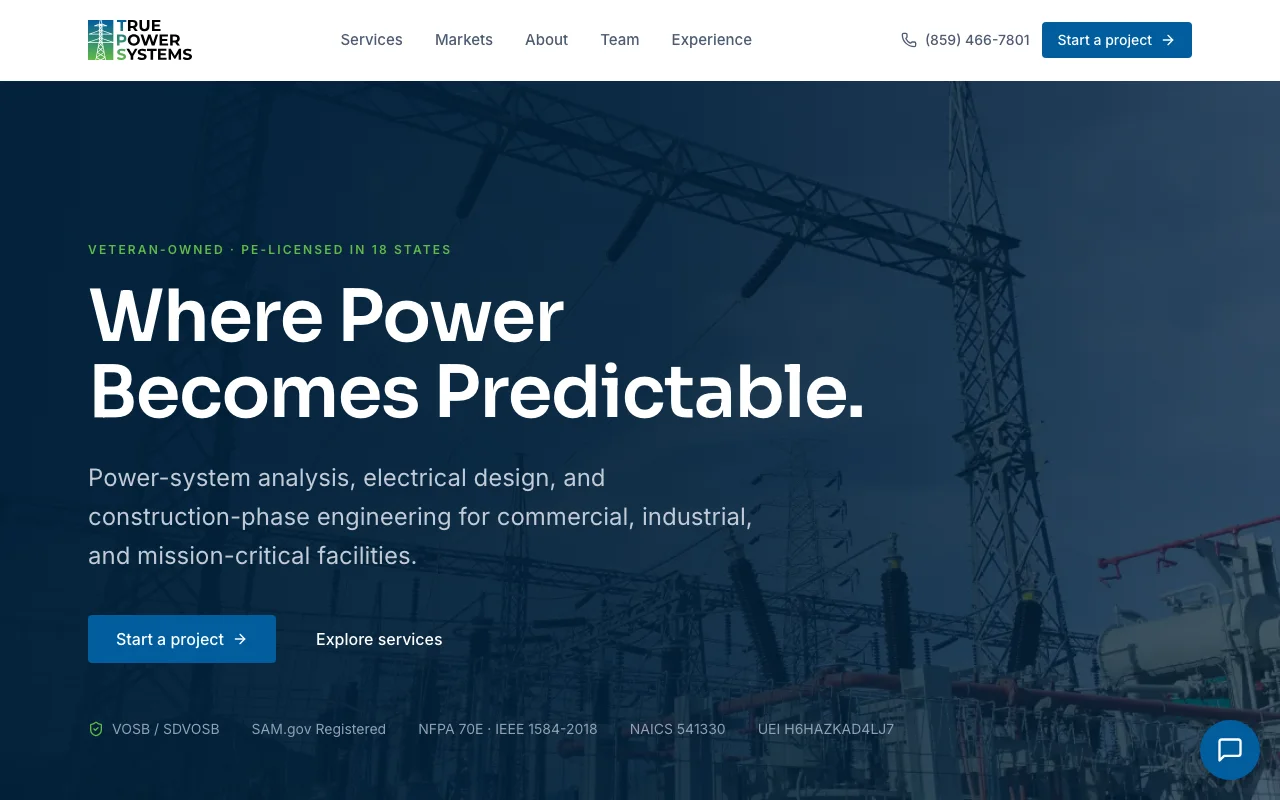
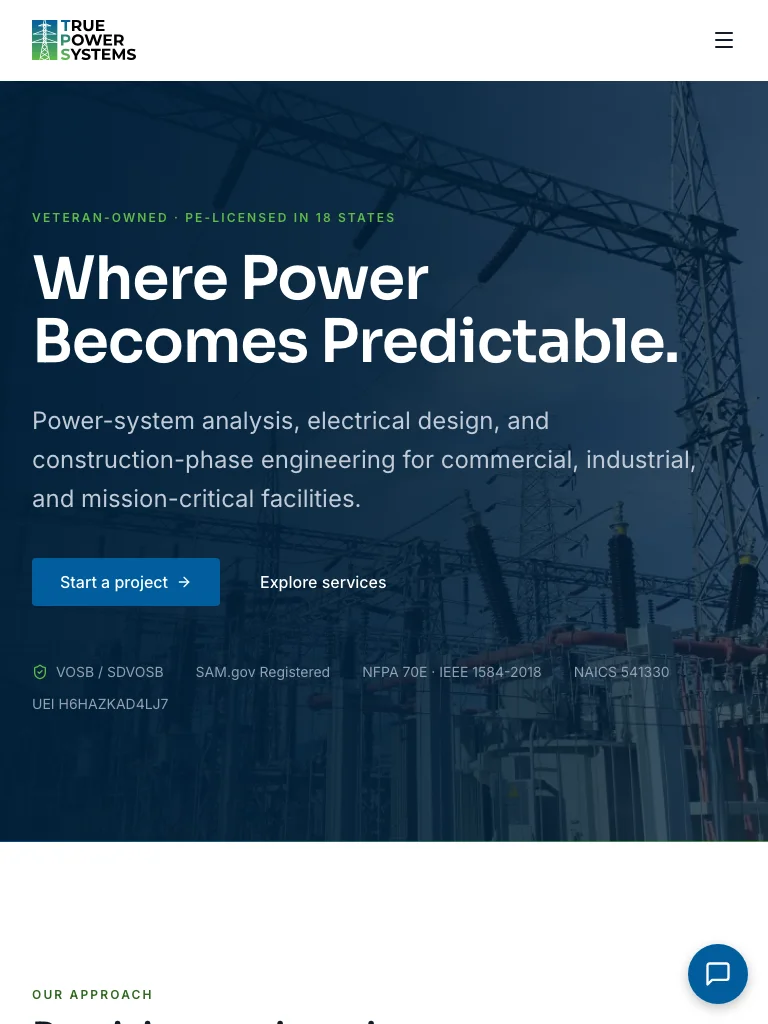
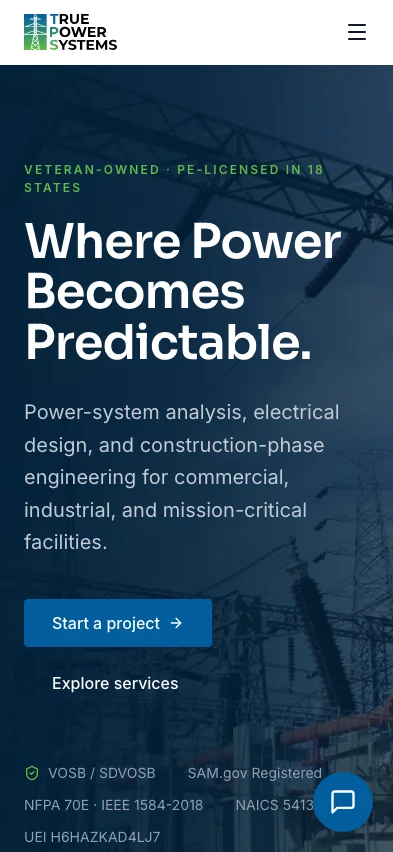
We built a 54-page Next.js firm site in six weeks, with services, markets, the team's credentials, and the government identifiers (UEI, CAGE, NAICS) in the hero, where a public buyer looks first.
Result
The firm site launched May 12, 2026, with every page in its sitemap returning HTTP 200.
Challenge 02
Problem
One firm site can't rank in 24 states
Buyers of arc flash, short-circuit, and coordination studies search the service with their state attached, and the firms that come up are local. A Lexington firm doesn't show up for a Georgia facilities manager.
Solution
We built a power-studies site on its own domain for every state TPS is licensed in, all forked from one template with one config file per state.
Result
24 state sites were live by June 13, 2026.
Challenge 03
Problem
Twenty-four near-identical sites is what a doorway network looks like
A template forked 24 times is the fastest way to build the pattern search engines penalize: the same page with the place name swapped. The client also ruled out named clients and projects on the microsites.
Solution
Each state's config carries its actual power landscape: its regulator, wholesale grid operator, utilities, OSHA jurisdiction, BLS establishment counts, and its own FAQ. Ohio's site is about PJM and federal OSHA; Texas's is about ERCOT, SPP, MISO, and WECC.
Result
The sites share a layout, not content.
Challenge 04
Problem
MEP design is bought by people who read drawings for a living
Architects and developers judge an MEP engineer by whether they know the state's adopted code editions, and third-party code aggregators had Kentucky's mechanical, electrical, and plumbing editions all wrong.
Solution
We built 10 MEP sites as drawing sets: a cover sheet with a real sheet index, a code summary sheet (G-001) with every edition read from the state's own publication and stamped with its verification date, and the contact form as the transmittal (T-001).
Result
The MEP template scores 91 on mobile Lighthouse (median of three runs on mep-oh.com) with zero layout shift.
Strategy
How the work ran
4 phases, in the order they happened.
Phase 01
The firm site
There was nothing to migrate, so we planned the site from what TPS sells, the markets it serves, and the states it's licensed to stamp in, then built 54 pages in Next.js in six weeks.
- Information architecture for 54 pages
- Government identifiers above the fold
- Team and credentials pages
- Launched May 12, 2026
Phase 02
The state power-studies network
One template, one config file per state, and each state's real power landscape in that file: regulator, grid operator, utilities, OSHA jurisdiction, industry data, and FAQs. Ohio first, the day after the firm site; all 24 by June 13.
- 24 state domains
- State regulatory and grid content
- BLS QCEW industry data per state
- FAQPage schema per state
Phase 03
The MEP drawing-set network
A second template for a second audience: architects and developers. Every section is a sheet with a title strip, and the code summary is verified against each state's own publication.
- 10 MEP state sites
- Sheet G-001 code summaries with verification dates
- Transmittal contact form
- Live August 14, 2026
Phase 04
One pipeline
All 35 sites run on one Sonor project with a managed form each, and every submission is tagged with the host it came from, so one queue still shows which state produced the lead. Submissions are screened by proof of page load rather than CAPTCHA.
- 35 managed forms
- Per-site lead attribution
- Site-filtered analytics
- Spam screening without CAPTCHA
Results
What it delivered
7 outcomes: 4 measured, 3 client-reported.
The numbers
70%
Most inquiries came through a microsite
Measured
From June 1 to September 25, 2026, 14 of the 20 form inquiries that passed spam screening came through 12 different microsites, not the main site. Phone calls and direct emails aren't in the count.
54 pages
A 54-page firm site replaced a placeholder
Measured
13 service pages, 7 market pages, 24 state pages, three category hubs, and seven core pages including About, Team, Experience, and the government MSA page. The site it replaced had one page.
35 sites
35 sites, one lead pipeline
Measured
A firm site, a power-studies site for each of the 24 states TPS is licensed in, and 10 MEP design sites. Every one has its own managed form, and every submission lands in one Sonor queue tagged with the site it came from.
8 engineers
TPS went from two engineers to eight
Client-reported
Reported by Scott Mann, Director of Business Development, True Power Systems, September 25, 2026
Two engineers on February 1, 2026. The eighth was hired in September.
4x
TPS monthly revenue up 4x since February
Client-reported
Reported by Scott Mann, Director of Business Development, True Power Systems, September 25, 2026
September 2026 against February 2026, with 5x expected by year end. The growth has more than one cause, including TPS's own business development and hiring.
$1M
$1M in signed work TPS traces to web leads
Client-reported
Reported by Scott Mann, Director of Business Development, True Power Systems, September 25, 2026
In the six months to September 25, 2026, TPS signed $1M of work with clients whose first contact came through the firm site or one of its 34 microsites.
Outcomes
Measured
Code editions verified at the source
Every adopted code edition on the 10 MEP sites was read from the state's own publication and stamped with its verification date, after third-party aggregators turned out to be wrong about Kentucky's mechanical, electrical, and plumbing codes.
Live analytics
▲ 1320.6%
Sessions
97 to 1,378, since launch
▲ 100%
Page Views
0 to 1,630, since launch
▲ 100%
Conversion Rate
0 to 0.65, since launch
Read from the live site against its pre-launch baseline.
Performance
What Lighthouse says
Google Lighthouse, measured on the live build.
Lighthouse
Site architecture
How the site is built
54 pages across 5 categories, laid out the way the site is.
- Homepage1 page
- True Power Systems · Where Power Becomes Predictable
- Top-Level Pages9 pages
- About | True Power Systems
- Contact | True Power Systems
- Distributor Program
- Experience | True Power Systems
- Government Master Service Agreements | True Power Systems
- +4 more
- Locations24 pages
- Electrical Engineering in Alabama | True Power Systems
- Arkansas
- Electrical Engineering in Florida | True Power Systems
- Electrical Engineering in Georgia | True Power Systems
- Illinois
- +19 more
- Services13 pages
- Arc Flash Hazard Analysis | True Power Systems
- Coordination Studies
- Data Center Mission Critical
- Duct Bank Design
- Duct Bank Heat Studies
- +8 more
- Markets7 pages
- Data Centers
- Education
- Government Municipal
- Healthcare
- Industrial Manufacturing
- Retail
- Water Wastewater
Totals
54
Pages built
5
Content categories
6,692
Words of content
Every page in the tree above is a page the site serves, grouped as the navigation groups it.
Tech stack
What it's built with
6 technologies across 6 categories.
Framework
Next.js
We used Next.js for a fast, scalable foundation that supports SSR, SSG, and modern performance optimization.
Frontend Library
React
We built the interface in React to create reusable components, cleaner front-end architecture, and a more maintainable codebase.
Programming Language
JavaScript
We used modern JavaScript to power the application logic and interactive front-end behavior.
Markup
HTML5
We used semantic HTML to improve accessibility, structure, and technical SEO.
Styling
CSS3
We used modern CSS for responsive layouts, visual consistency, and efficient front-end styling.
Performance Auditing
Lighthouse
We used Lighthouse to validate performance, SEO, accessibility, and best-practice outcomes before and after launch.
Services
What we delivered
4 services, and what each one covered.
Service 01
A 54-page firm site
The firm site a prequalification reviewer needs, replacing a one-page placeholder.
- Service, market, and state pages
- Team credentials
- Government identifiers above the fold
- Government MSA page
Service 02
A 24-state power-studies network
A site on its own domain for every state TPS is licensed in, each built from that state's regulator, grid, utilities, and OSHA jurisdiction.
- One template, one config per state
- State-specific grid and regulatory content
- BLS industry data
- Per-state FAQ and schema
Service 03
A 10-state MEP network
MEP design sites laid out as drawing sets for the architects and developers who buy MEP design.
- Cover sheet with sheet index
- Code summary verified at the source
- Services schedule
- Transmittal contact form
Service 04
One Sonor lead pipeline
35 managed forms in one project, every lead tagged with its originating site.
- Per-site attribution
- Site picker in analytics and forms
- Proof-of-page-load spam screening
- One queue for business development
Project details
What the job was
The particulars of the build, as the record states them.
Industry
Electrical Engineering
Website
Delivered in
Firm site in 6 weeks; 35 sites live by August 14, 2026
Launch date
May 12, 2026
What's next
Need a faster website for your industrial services business?
We help industrial and field-service companies replace outdated websites with high-performance platforms that load fast, rank cleanly, and support real business growth.